

Buying a luxury property is an investment in quality of life, but it must also be a financially sound decision for the future. In the current prime real estate market, Energy Efficiency Class A has evolved from a simple label into the definitive indicator of construction quality and, crucially, long-term economic savings.
At Casilla de Costa (Fuerteventura), our new-build villas are not only defined by exclusive design but also by holding the highest EPC (Energy Performance Certificate) rating. But what does owning a “Class A” property really mean, and how does it impact your monthly outgoings?
What does the ‘Class A’ label actually mean?
The Energy Efficiency Class A label represents the highest tier within the official European certification system. Beyond the certificate, this indicates that the property has been designed as a NZEB (Nearly Zero-Energy Building).
For the homeowner, this translates into two fundamental pillars:
- Minimal Energy Consumption: The house requires very few resources to maintain optimal comfort levels.
- Low Emissions: A drastic reduction in the carbon footprint, often achieved through renewable energy integration.
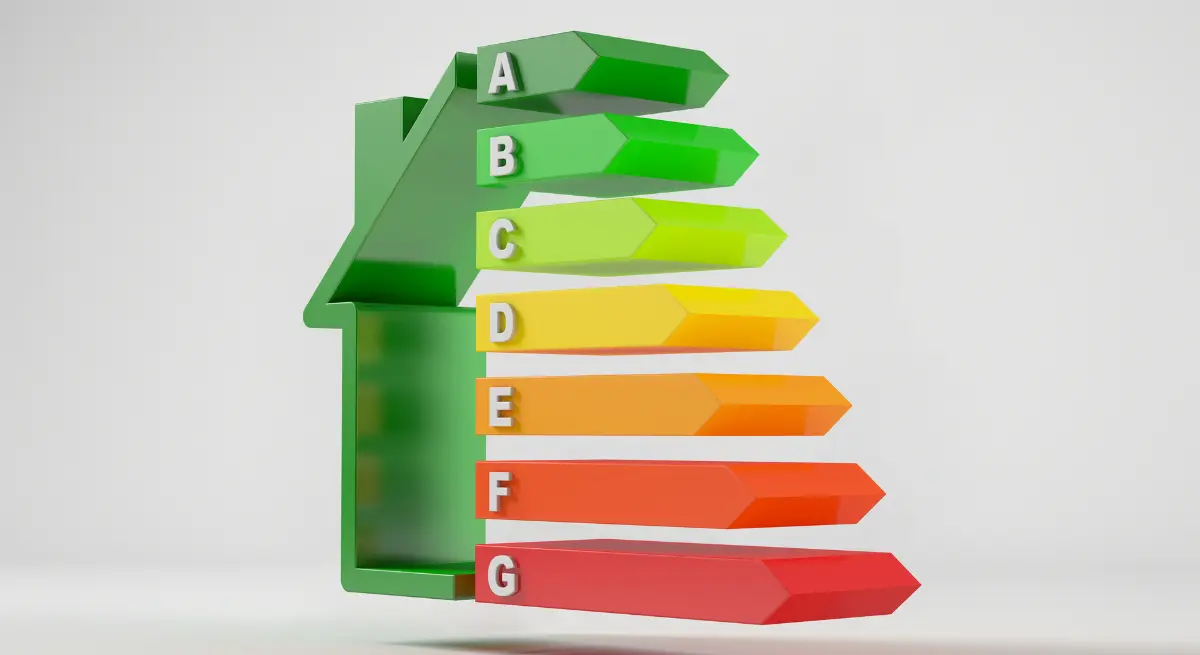
The financial impact: Tangible savings on electricity bills
The economic difference between an efficient home and a conventional one is highly significant and noticeable from the very first utility bill.
According to comparative consumption data:
- Vs. Older or Standard Properties: A home with Energy Efficiency Class A consumes between 60% and 70% less.
- Vs. Average Ratings (Class D or E): Savings sit between 50% and 60%.
These accumulated savings accelerate the amortization of your initial investment, whilst future-proofing your household finances against energy price volatility.
Invisible technology: Why do these villas consume so little?
Achieving Energy Efficiency Class A is not a coincidence; it is the result of advanced construction systems. In Fuerteventura, where climate control (managing wind and sun) is vital, we apply three key technologies:
1. The Thermal Envelope (Superior Insulation)
The secret lies in the villa’s “skin”. A high-density thermal insulation system in facades, roofs, and floors prevents temperature leakage.
- Includes carpentry with thermal bridge breaking and low-emissivity glass.
- Result: The interior remains cool and stable without the need for constant air conditioning.
2. Aerothermal Energy: Smart Climate Control
We replace traditional boilers with aerothermal systems (Air Source Heat Pumps), a clean technology that extracts energy from the outside air to provide cooling, heating, and hot water.
- Extreme Efficiency: For every 1kW of electricity consumed, it generates between 3 and 4kW of thermal energy.
- Gas-Free: Eliminates the need for gas supplies, simplifying bills and increasing safety.
3. Photovoltaic Self-Consumption
The integration of solar panels allows the villa to generate its own clean energy. During peak sunlight hours in the Canary Islands, grid consumption can drop to practically zero.
Benefits beyond the bill: “silent luxury”
Choosing a property with Energy Efficiency Class A at Casilla de Costa delivers advantages that go beyond the financial aspect:
- Thermal & Acoustic Comfort: The insulation that protects against heat also isolates against noise (essential on windy days), creating quieter, more stable homes year-round.
- Higher Resale Value: Efficient properties command a higher market valuation and sell faster, consolidating the real estate asset as a solid investment.
- Durability: Efficient design implies better long-term building performance and lower maintenance requirements.
FAQ: Energy efficiency in the Canary Islands
What exactly does Energy Efficiency Class A mean?
It means the property has the highest possible energy rating, utilizing optimized design and systems to achieve near-zero energy consumption.
Will I really notice the difference in electricity bills?
Absolutely. Lower consumption drastically reduces monthly expenses, especially regarding climate control, achieving savings of up to 70% compared to older buildings.
Is high efficiency necessary in the Fuerteventura climate?
Yes. While we don’t have freezing winters, Fuerteventura has heat and wind. Class A insulation keeps the house cool in summer and dry in winter without relying heavily on AC, which is the main electricity drain in the islands.
Are efficient homes more expensive to buy?
The initial investment may be slightly higher due to premium materials (insulation, aerothermal systems), but this is quickly offset by monthly savings and the property’s superior asset value.
Do I need air conditioning in a Class A villa?
You might use it occasionally, but significantly less than in a standard home. The thermal envelope maintains the indoor temperature, minimizing the need for mechanical cooling.
Conclusion
Choosing a new-build villa with Energy Efficiency Class A is a smarter way to understand real estate investment. It not only reduces costs but enhances daily living comfort and secures your asset’s value for the long term.
At Casilla de Costa, energy efficiency is part of our design DNA. Are you ready to invest in a home that provides silent luxury and constant savings?