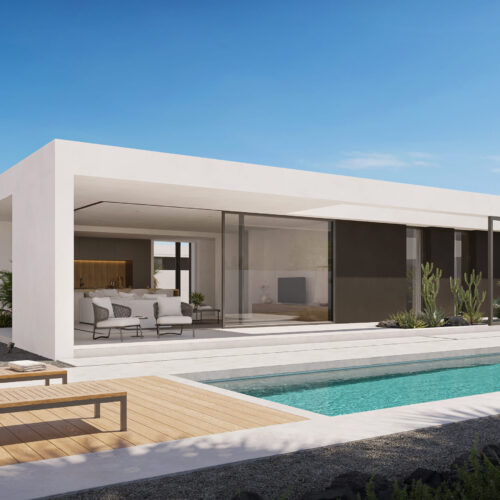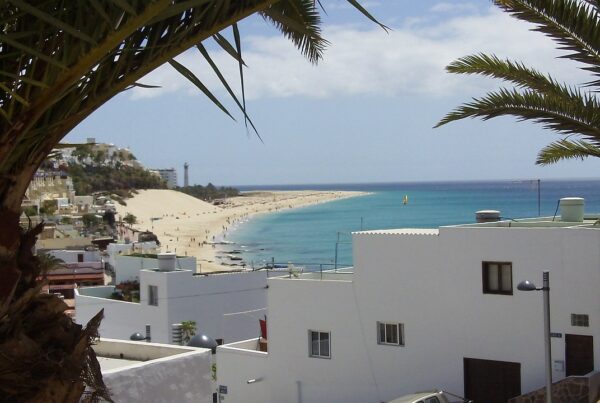

Acquiring a high-standing property is not an impulsive transaction; it is an operation of heritage and lifestyle. In the luxury market, an aesthetic “crush” is dangerous if it is not accompanied by a rigorous technical and legal audit.
A villa may look stunning at first glance, but if it does not meet adequate technical, energy, or legal standards, its real value can be compromised in the medium and long term. If you are considering a purchase in the north of Fuerteventura, this checklist for buying a house is designed to filter the “good” from the “exceptional”.
Here are the 10 critical questions you must ask yourself (and the developer) before signing.
1. What is the real Energy Efficiency and how is it achieved?
In modern luxury, an Energy Rating A is non-negotiable. But do not just stick with the letter on the paper.
- The expert question: “What active and passive systems guarantee this efficiency?”
- What to look for: In Fuerteventura, thermal insulation is vital not only for heat but to protect the home from wind and nighttime humidity. Look for Aerothermal systems (Air Source Heat Pumps) for hot water and pre-installations for photovoltaics. An efficient house is a comfortable and silent house.
2. Is there total Legal Security (especially on the coast)?
The legal situation in the islands can be complex due to the Coastal Law and local regulations.
- The key document: Do not sign anything without seeing the updated Nota Simple (Land Registry Extract) and, if it is a new build, the building license and the License of First Occupation (LPO) or proof of its advanced processing.
- The safety factor: Ensure the property has no open urban planning infringement files. At Casilla de Costa, registry transparency is the first pillar of our brand.
3. How does the villa interact with the Trade Winds (Alisios)?
This is a rookie mistake in the Canaries. A spectacular villa with a poorly oriented pool can be unusable for half the year due to the wind.
- Exterior Checklist:
- Is the pool area protected from the North/North-East?
- Does the architectural design create “bubbles of calm” on the terraces?
- South/South-West orientation is usually the most sought-after to maximize outdoor use year-round.
4. What is the quality of the “invisible” materials?
Salt mist (salitre) is the silent enemy of coastal constructions. Luxury is not just marble on the floor; it is what lies beneath.
- Technical question: “What treatment does the exterior carpentry have, and what type of waterproofing was used on the roof and foundations?”
- The right answer: You must demand high-end aluminum carpentry with thermal breaks and low-emissivity glass. If materials are not prepared for marine conditions, maintenance costs will increase significantly over time.
5. Does the plot guarantee real privacy in the future?
True luxury is invisibility. It is not enough to have no neighbors today; you must know what will happen tomorrow.
- Surroundings Analysis: Check the General Urban Plan (PGO) of the area. Are those volcano or sea views perpetual, or are there buildable plots in front? Ensure that perimeter walls and the elevation of the villa protect you from prying eyes from the street or neighboring houses.

6. Are the down payments Bank Guaranteed?
If you buy off-plan (new build), this is your money’s safety net.
- The requirement: Spanish Law obliges the developer to guarantee amounts paid on account via a Bank Guarantee or insurance policy. We recommend not making any payment without this documentary backing, which ensures the return of funds if the work is not delivered.
7. Is the property ready for High-Speed Connectivity?
The profile of the luxury buyer has changed: many are high-level “digital nomads”.
- The proof: Do not assume there is internet. Verify that the urbanization has a real Fiber Optic deployment. In exclusive but isolated areas, this makes the difference between being able to live there all year round or only on weekends.
8. What are the fixed maintenance costs (OPEX)?
A luxury villa has operating costs. Knowing them beforehand is a sign of financial intelligence.
- The breakdown: Ask for a realistic estimate of Community fees (if applicable), pool and garden maintenance (water in the Canaries is a precious and expensive commodity), and IBI (Council Tax equivalent).
9. Who is the developer, and what After-Sales service do they offer?
The relationship does not end at the Notary.
- Investigation: What other projects has the developer delivered on the island? Do they have a physical local office to go to if a problem arises? The solvency and reputation of the builder are the best guarantee of the construction quality and after-sales service you can expect.
10. Does the location have solid Capital Appreciation potential?
Finally, think about the exit strategy.
- The investor criterion: Look for areas with “scarcity”. Places like Villaverde or Lajares have extremely high demand and limited land supply. This ensures that if you decide to sell in 5 or 10 years, the capital gains will not only cover inflation but generate profit. Avoid mass-market areas where your villa will compete with hundreds of identical ones.
Conclusion: The difference between buying a house and making an investment
This home buying checklist is your first line of defense. If a property cannot satisfactorily answer these 10 questions, it is probably not the premium asset you are looking for. At Casilla de Costa, we design every villa having these answers resolved in advance, because we understand that luxury is, above all, the peace of mind of having made the right choice.