

Do you know what colors will suit the spaces in your home?
How to combine colors in the decoration of your home will surely make you think about what are the guidelines that must be followed to obtain the right choice and selection of tones for a project. Learn about the different factors that will determine the ideal color style for your home, with the help of Liliana Millán, architect and specialist in the design and integral rehabilitation of homes, offices and tourism ventures. A home has different identities that we can help to capture through a particular style.
The atmosphere is generated by the architecture itself, the furniture, the lighting, the accessories.
For all these elements to behave as a unit, they must be linked by a color code. For this, to find the ideal chromatic range, it is necessary to study other variables (apart from our personal taste) much more tangible and measurable, such as natural light, volume, the shape and surface of the floor, the typology of the house, location or climate.
Factors to study
-
- Location and climate. The location of your home. A cold climate, where rain predominates, could be compensated with light environments and warm textures. If you also live in the city, try to brighten up the interior with some color.
-
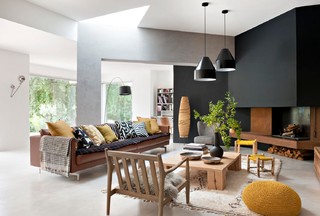
- Natural light. Once you start to find the possibility of adding color, the influence that natural light has on the interior comes into play. Notice if it is intense and constant or on the contrary is scarce and punctual. Natural light has the property of enlivening the colors and of tinting, or even varying, the shades depending on whether it hits the surfaces directly or indirectly; which can also give different scenes throughout the day.
-
- The white formula can even impoverish the space. Therefore, it is advisable to tone it down, for example, with a palette of natural whites, which will make the color a little more elaborate. You can also do it with washed pastels. That is why analogues are so important, because without leaving the range, we raise or lower the light intensity through shades.
-
- Duplicate natural light. Light can also be distributed in the environment by reflection. Use mirrors to increase the flow of light or to move images from one space to another. In addition to breaking the monotony of a wall with a scene that changes with the time of day, you can use this composition as a starting point for creating a color palette. Glossy and satin paints also add luminosity.
-
- Surface and volume. Finding your color scheme involves working first of all with an overall idea, in which you have to see how the chosen palette affects the proportions of the environment.in a small space, for example, are not recommended contrasts between colors, because they create a sense of spatial overwhelm, nor decorative paints, as they saturate the environment and dwarf it. On the other hand, these aspects also have a negative influence on the furniture, which would pass to the background, practically absorbed by the visual weight of the enclosure.
-
- Typology and architectural style. The color code can help you to break clichés or to revalue features that give personality to the space, as in the case of nineteenth-century style homes. The decorative details that they usually have can serve to enrich the proposal. The boiseries, high baseboards or cornices …, if painted white walls and ceiling, the volume expands and gives more prominence to the floor, hydraulic tiles, floorboards, checkerboards, etc.
The structure is also a source of inspiration. Use a floor slab of vaults or joists, wooden or steel pillars to create contrasts. You can also reduce their presence by integrating them into the color of the walls.
- Typology and architectural style. The color code can help you to break clichés or to revalue features that give personality to the space, as in the case of nineteenth-century style homes. The decorative details that they usually have can serve to enrich the proposal. The boiseries, high baseboards or cornices …, if painted white walls and ceiling, the volume expands and gives more prominence to the floor, hydraulic tiles, floorboards, checkerboards, etc.
There is always a starting point to find the axis of your color scheme. It can be in an upholstery, a painting or in some pieces of furniture. Once you have analyzed all the variables, you can choose your color code. To begin with, the wall is the one that will take the dominant hue, which should link all the elements that enter into the composition. It is followed, in a smaller proportion, by the color that you can use in baseboards, moldings and woodwork, which can be contrasting or, on the contrary, analogous and more neutral. Read previous article: How to heat your home economically